
Can Your Smartwatch Really Measure Blood Pressure?
Consumer smartwatches now routinely advertise blood pressure monitoring as a feature. This article examines why single PPG sensor based devices cannot perform true blood pressure estimation from a signal processing and algorithmic perspective, what pulse transit time actually requires at a technical level, and what to look for if continuous cardiovascular monitoring matters to you.
The Blood Pressure Feature Your Smartwatch Is Selling You
Can smartwatches truly deliver accurate cardiovascular health data? Samsung, Withings and Apple all claim their devices can monitor your cardiovascular health from your wrist. But despite what these manufacturers claim, answering that question requires an honest look at signal quality and the fundamental design limitations of how these devices actually work.
How Pulse Transit Time Actually Works
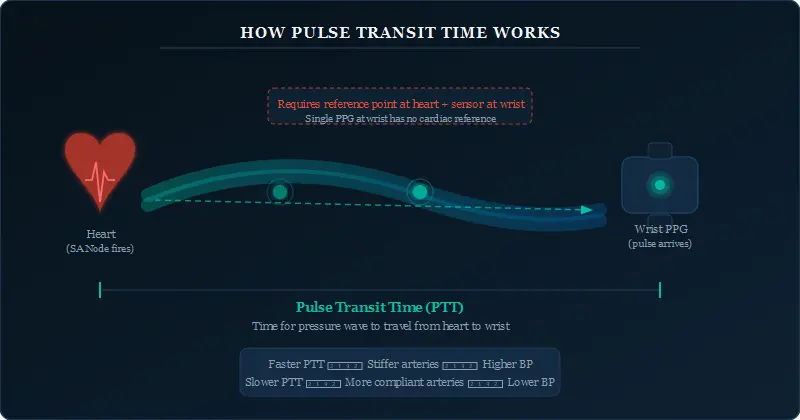
Pulse Transit Time is determined by measuring the interval between two events: the electrical firing of the sinoatrial node that initiates a heartbeat, and the moment the resulting pressure wave reaches its peak at a peripheral measurement site such as the wrist. When the distance of that pathway is factored in, it becomes possible to approximate the velocity at which blood travels through the vessels. This velocity gives us meaningful information about vascular health and arterial compliance.
The Limits of Pulse Transit Time
However, PTT based estimation is not without limitations. It remains an approximation, and error margins vary significantly between individuals depending on age, arterial stiffness, and physiological condition. The method cannot be considered stable across diverse populations. And critically, even this imperfect approach is not what most consumer smartwatches are actually implementing.
Why One Sensor Is Not Enough
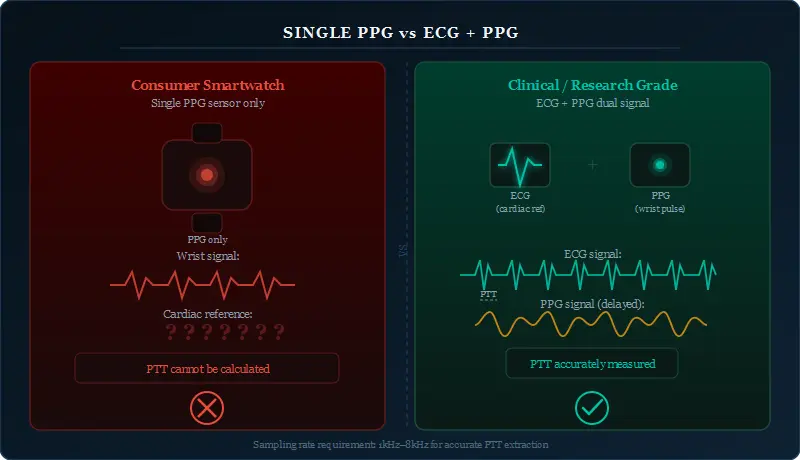
PPG sensors work by emitting LED light into the skin and measuring the returning signal to detect pulse. This requires constant skin contact and a clean optical signal. The fundamental problem for blood pressure estimation is straightforward: without a reference point at the heart, there is no way to calculate how long it takes for the pulse wave to travel from the heart to the wrist or fingertip. The transit time calculation is incomplete before it even begins.
The Problem With Wrist Based Optical Sensing
PPG does not perform equally across all individuals. In cold environments, or in clinical settings where a patient’s body temperature is deliberately kept low, peripheral blood flow decreases and the signal weakens. The characteristic peaks and troughs that algorithms rely on become less pronounced. When peak detection fails, transit time calculations produce jumps, skips, or values that are simply wrong. If your physiology makes clean PPG recording difficult at the wrist or hand, the device has no way to account for this. The errors you see will be yours alone.
You Are Being Fitted Into Someone Else’s Model
When companies describe their devices as offering personalized blood pressure monitoring, the reality is more limited than the term implies. Calibration does not happen in your home with a cuff device after purchase. Instead, manufacturers collect clinical data during development, compare PPG derived transit time values against reference blood pressure measurements, and build a mathematical model that maps transit time to a blood pressure value. Some devices incorporate additional variables such as age, weight, and arm length to refine this mapping. But this is population level modeling, not individual calibration. When you enter your details at setup, the device is not learning your physiology from scratch. It is placing you into a pre-existing model built on someone else’s data.
The Variables No Model Can Predict
The population model a device is built on cannot account for how your physiology changes over time. Age is one of the most significant factors. As arteries stiffen with age, blood flow dynamics at vascular bifurcations change, and the hydraulic resistance encountered by the pulse wave shifts in ways that move individual measurements away from what the model predicts. Cardiovascular disease, hypertension, and diabetes alter the physical properties of the circulatory system directly, changing vascular resistance in ways that further separate real measurements from model expectations.
Even in devices that compare two signals such as ECG and PPG to estimate transit time, the relationship between those two signals is not fixed. It shifts with circadian rhythm throughout the day. Poor sleep, excessive caffeine intake, and acute stress all affect the correlation between cardiac and peripheral signals in ways that introduce additional error. The model was not built on your bad night’s sleep. It has no way to account for it.
The Hardware Gap Consumer Devices Cannot Close
Single PPG smartwatches cannot replace devices capable of using multiple signals for pulse transit time calculation. The model’s requirements make this impossible. For real-time blood pressure estimation using two signals, both must be properly synchronized and share identical sampling timestamps. Extracting the functional connectivity between two signals demands sampling rates between 1kHz and 8kHz, well above what most clinical devices use, and far beyond what consumer smartwatches typically offer.
Battery life is an additional constraint unique to smartwatches. Manufacturers consistently favor lower sampling rates to extend battery performance, which comes at the cost of signal fidelity. As a result, consumer devices will likely continue producing approximate values through AI-assisted modeling rather than true physiological measurements.
Knowing this matters. These devices have limited applicability in clinical settings. Where they may genuinely help is in motivating daily movement, or in alerting a user during exercise when blood pressure readings approach a personal threshold. That is their realistic ceiling, and it is worth being clear about it.
How to Choose What Actually Works for You
For users who want daily motivation and personal trend tracking, smartwatches are a practical choice. They require no additional electrodes or setup, and for that purpose they are reasonable tools. But they cannot replace gold standard cuff devices for monitoring conditions where accuracy is clinically significant, such as hypertension. In any medical context, cuff measurement remains the standard.
For users who want continuous blood pressure estimation beyond what a cuff provides, devices combining both ECG and PPG sensors with high sampling rates are the more appropriate option. The position of the ECG electrode matters here. There must be a measurable distance between the cardiac electrical signal and the peripheral PPG measurement point. Devices that ask users to input arm length are accounting for this distance, which indicates a more rigorous approach to the underlying calculation. Similarly, systems that allow users to enter age, weight, and height incorporate more variables into their model and are preferable to those that do not.
Beyond blood pressure alone, better systems provide broader cardiovascular context, including approximate assessments of arterial stiffness, presented within a more complete dashboard rather than a single number.
If a device connects to an online service, data privacy and the company’s relevant certifications deserve attention. Cloud connected devices have the potential to improve over time by incorporating individual data into their models, but whether a company actually uses data this way for individual optimization is rarely disclosed. Algorithms in this space are not typically made public, and that opacity is worth factoring into any decision.
Where the Technology Stands Today
Meaningful options already exist in the market for users who understand what they are looking for. But the gap between consumer device output and true blood pressure measurement remains real. The technology is not static, and there is genuine room for improvement, particularly as signal acquisition hardware and individualized modeling continue to develop. For now, knowing where that gap stands is the most useful thing a user can have.
Hey can you suggest me a smart watch for blood pressure thanks